

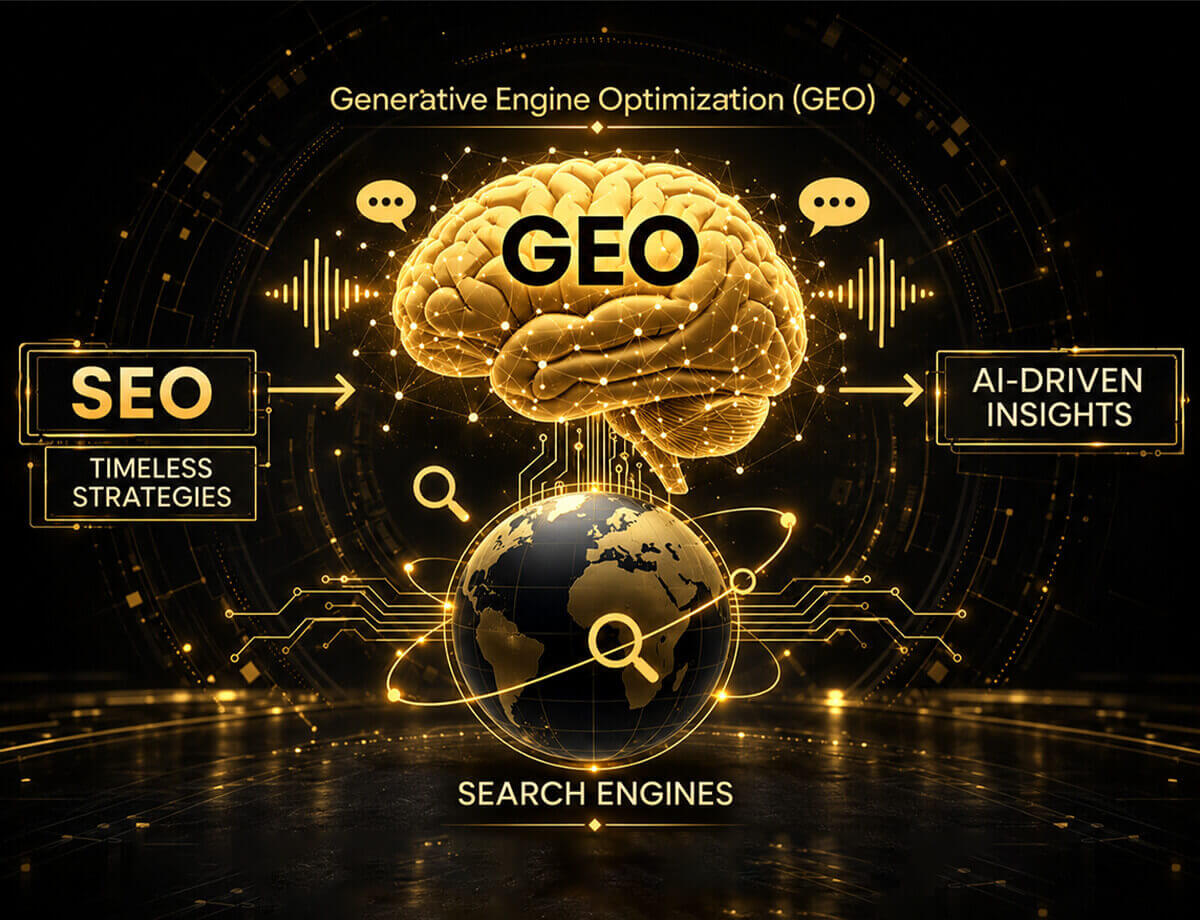
What Is GEO Generative Engine Optimization?
GEO (Generative Engine Optimization) is the practice of optimizing content so AI-powered search engines and generative platforms can understand, use, cite, and recommend your brand in their answers. Unlike traditional SEO, which focuses on search rankings, GEO focuses on increasing your visibility within AI-generated responses across platforms such as ChatGPT, Google AI Overviews, and Perplexity.
What Is GEO Generative Engine Optimization?
Google refers to this process through concepts such as retrieval-augmented generation and query fan-out, which help its systems gather relevant information for more complex searches.
So, what is geo generative engine optimization? In simple terms, it is the process of making your brand and content easier for AI-driven search systems to find, understand, assess, and potentially include when generating answers.
However, GEO isn’t meant to replace SEO. Google states that established SEO best practices still apply to AI Overviews and AI Mode because these features rely on core Search systems. Factors such as technical accessibility, helpful content, internal linking, page experience, and accurate structured data remain important for making your website discoverable and understandable.
Why SEO Is Being Disrupted Right Now
Traditional search typically gives users a list of links and leaves them to decide which result is most useful. AI-powered search takes a different approach by delivering a direct answer and often showing the sources used to build that response.
This shift can change how and when businesses get noticed online. Someone searching for software, an agency, a product, or a professional service can now ask an AI platform to recommend options, compare providers, find alternatives, or suggest the right solution for their needs.
That is why generative engine optimization geo 2026 looks beyond a single search ranking. It builds on the fundamentals of SEO while also considering conversational queries, AI citations, source visibility, brand mentions, and how prominently a business appears within AI-generated answers.
What Generative Engine Optimisation (GEO) 2026 Means for Businesses
For businesses, GEO is about adapting to the way customers are increasingly using AI to research products and services, compare different options, understand unfamiliar topics, and make informed decisions.
That doesn’t mean creating dozens of pages to target every possible AI prompt. Google’s current guidance continues to emphasize original, useful, people-first content rather than content created mainly to influence generative search results.
A practical generative engine optimization geo definition should focus on the essentials: a technically sound website, genuinely helpful information, clear and consistent brand details, trustworthy supporting sources, and regular monitoring.
GEO 2026 vs Traditional SEO: Strategy, Execution and Measurement
Strategy: Traditional SEO usually revolves around keywords, search rankings, competitors, technical performance, and content gaps. GEO in 2026 expands that approach by looking at conversational searches, AI recommendations, comparisons, and how often a brand appears in generated answers.
Execution: SEO focuses on improving website pages, content, and authority. GEO goes a step further by considering whether important information is clear, easy for AI systems to find and understand, supported by reliable sources, and consistently connected to the brand.
Measurement: Traditional SEO commonly tracks rankings, impressions, clicks, organic traffic, and conversions. AI visibility introduces additional signals such as brand mentions, citations, AI share of voice, cited domains, prompt coverage, and influence within generated answers. Recent research also suggests that simply counting citations may not tell the whole story, since different sources can have different levels of influence on the final AI response.
The 10 Pillars of Generative Engine Optimization GEO 2026
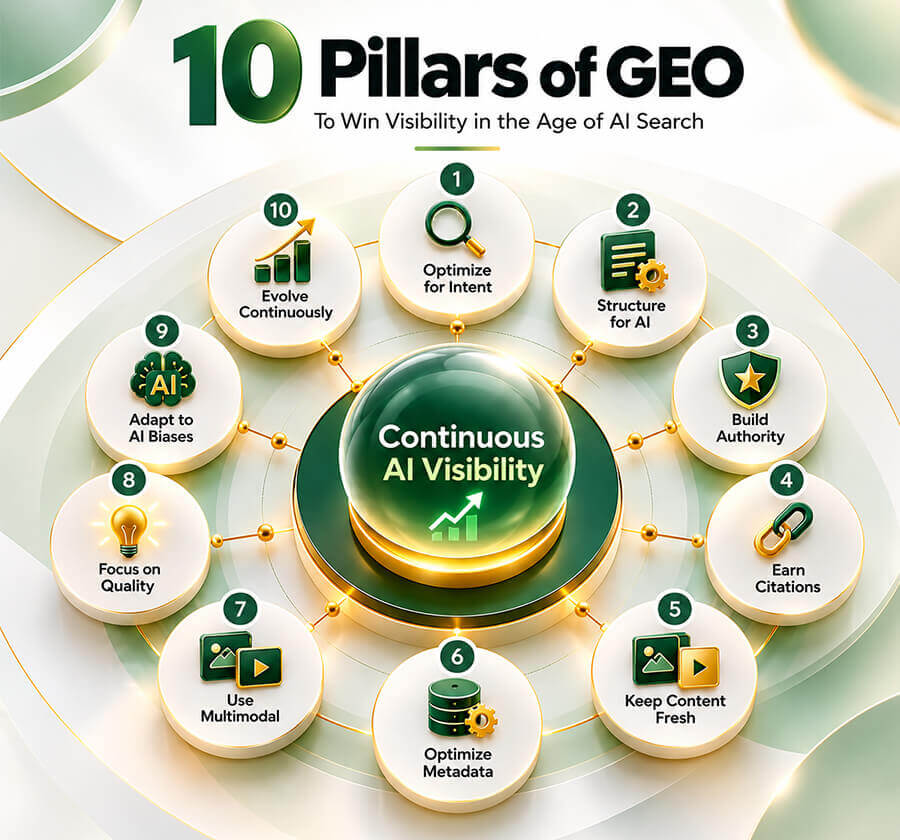
Pillar 1 – Brand Recognition
For AI systems to understand a business properly, they need clear information about what the company does, the products or services it provides, the people it serves, its location, and what makes it different from competitors.
Consistent business names, accurate service descriptions, product details, location information, author profiles, and connected brand properties all help build a clearer online identity.
This is an important part of a generative engine optimization geo definition because AI systems need to recognise a business as a distinct entity and connect it with the right industry, services, and areas of expertise.
Pillar 2 – Authoritative Third Party Citations
A 2025 study of generative search found that the systems examined showed a notable preference for earned media and authoritative third-party sources, although the results can differ depending on the platform and query.
Industry publications, expert contributions, reviews, research, interviews, directories, and trusted communities can all add useful context around a brand.
The goal isn’t simply to collect as many mentions as possible. What matters is having credible sources that accurately represent the business and reinforce the expertise it actually provides.
Pillar 3 – Conversational Content Optimisation
People often type complete questions, describe a problem, or ask for recommendations in a conversational way. Your content needs to address that underlying intent.
A useful page should ideally provide a clear answer early on and then expand with supporting information, examples, exceptions, and practical advice. Well-organised headings, definitions, comparisons, statistics, and step-by-step guidance can also make information easier to understand and extract.
That makes conversational content a practical part of what is geo generative engine optimization: creating useful answers for natural-language searches while keeping the content genuinely helpful for human readers.
Pillar 4 – Generative Engine Optimization GEO Tracker Implementation
Traditional SEO tools can tell you where a page ranks in search results, but they don’t provide the full picture of how a brand appears inside AI-generated answers. A dedicated generative engine optimization (geo) tracker can help monitor prompts, brand mentions, citations, competitors, cited websites, and visibility across different AI platforms.
Several commercial platforms now offer parts of this type of tracking. For example, Ahrefs Brand Radar provides data around mentions, citations, impressions, and AI Share of Voice across multiple AI environments.
You want to know which prompts trigger your brand, which competitors appear alongside you, which websites AI systems repeatedly rely on, and which of your pages are being retrieved without actually being cited.
Pillar 5 – Topical Authority and Depth
Having a large number of related pages doesn’t automatically make a website authoritative. What matters is whether the site provides useful and well-connected information that covers the subject from different angles.
Include definitions, common concerns, comparisons, use cases, practical advice, and supporting information where relevant. Then connect related pages through sensible internal links so users and search systems can understand how the topics relate to one another.
Recent GEO research has linked factors such as topical relevance, content structure, and extractable evidence with citation and answer influence. At the same time, research also shows that there isn’t one fixed formula that guarantees visibility across every AI system.
Pillar 6 – Structured Data
Structured data gives search engines additional context about the information presented on a webpage. Depending on the content, it can be used for organisations, products, articles, breadcrumbs, events, and other supported content types.
That said, schema shouldn’t be treated as a special trick for getting mentioned by AI. Google has stated that there is no specific schema markup required for AI Overviews or AI Mode, and any structured data used should accurately represent the visible content on the page.
For generative engine optimization geo 2026, schema is best considered part of a strong technical SEO foundation that helps search systems interpret website information more effectively.
Pillar 7 – Multi-Platform AI Visibility Strategy
The same question can produce different answers depending on which AI platform is being used. Google has explained that AI Overviews and AI Mode can rely on different models and techniques, so the sources, answers, and links shown to users may not always be identical.
Because of this, businesses shouldn’t rely on testing their visibility on just one platform. Instead, identify the AI environments your target audience is using and test the important questions and prompts across them.
This is also why what is geo generative engine optimization cannot simply be explained as achieving one ranking position. GEO is about understanding where your brand appears, where it is missing, what sources are being used, and how those results change between platforms.
Pillar 8 – Real-Time Information and Content Freshness
Business information doesn’t stay the same forever. Products change, prices are updated, services are added or removed, locations move, policies change, and team information can become outdated.
For that reason, important pages should be reviewed regularly, particularly when they contain information that can change quickly. Keeping your website and major business profiles aligned with the latest information can reduce the chance of outdated details being picked up in future AI-generated answers.
Freshness shouldn’t mean constantly changing content just for the sake of it. The priority should be keeping important information accurate, useful, and reliable. Google’s current guidance also places emphasis on helpful and trustworthy information, while its generative search features use retrieved web content to support their responses.
Pillar 9 – User Generated Content and Social Proof Signals
The information available about a business doesn’t come only from its website. Customer reviews, community discussions, forum posts, videos, social content, and personal experiences can all contribute to the wider online picture of a brand.
The focus should be on building genuine customer feedback rather than creating artificial praise. Encourage customers to share their real experiences, respond thoughtfully to negative and positive feedback, and make important business information easy for people to verify.
Social content can also contribute to search visibility. Google has introduced Search Console platform properties for eligible content from platforms such as Instagram, TikTok, X, and YouTube, giving creators and site owners additional ways to understand how this content performs across Search and Discover.
Pillar 10 – GEO Performance Measurement and Iteration
Tracking whether your brand appeared in an AI answer once isn’t enough to understand GEO performance. A useful generative engine optimization (geo) tracker should help you identify patterns over time across prompts, platforms, competitors, mentions, citations, and the sources being used.
A practical measurement framework can look at several stages:
Discoverability – Did the AI system find and retrieve your brand or webpage?
Mention – Was your brand actually named in the generated response?
Citation – Was your website or another source connected to the answer through a citation or link?
Influence – Did the cited source meaningfully shape the information included in the response?
Business outcome – Did that visibility contribute to website visits, enquiries, branded searches, leads, or sales?
This distinction is important because being cited doesn’t necessarily mean a source had a major impact on the final answer. Recent research increasingly looks beyond simple citation counts to understand how much influence individual sources have on AI-generated responses.
What Is GEO Generative Engine Optimization (How It Differs From Traditional SEO)
Google uses terms such as AEO and GEO to describe efforts focused on improving visibility within AI-powered search experiences. At the same time, these approaches still build on many of the established principles of search optimisation.
So, what is geo generative engine optimization in practical terms? It is a way of looking at search visibility through the lens of AI. Instead of focusing only on where a webpage ranks, it considers how AI systems find information, evaluate sources, generate responses, and decide which brands or websites to include.
The Intent Difference
Traditional search often begins with a short phrase such as “best CRM for startups.” With AI search, users can provide much more detail in a single prompt:
“Which CRM is easiest for a five-person startup that needs email automation and affordable pricing?”
This changes the content opportunity. Instead of simply targeting a keyword, businesses need to understand the complete question, problem, or decision the user is trying to solve.
That is a key part of the generative engine optimization geo definition: understanding the broader intent and conversation surrounding a search rather than focusing only on the exact words entered into the search box.
The Measurement Difference
Traditional SEO reports generally show where a webpage ranks for specific keywords. AI visibility is more complex. A brand might be retrieved by an AI system but never mentioned in the response. It might be mentioned without a citation, or cited without having a significant impact on the answer.
A dedicated generative engine optimization (geo) tracker can help make these differences easier to understand. It can track important prompts, brand mentions, citations, competing businesses, referenced domains, and pages that contribute to AI-generated responses.
Tools such as Ahrefs Brand Radar currently provide insights into AI mentions, citations, impressions, and AI Share of Voice. The system can also help identify pages and domains that are being cited in AI responses.
Google has also added reporting for eligible generative AI search features through Search Console, giving businesses another source of visibility data alongside traditional Search performance metrics.
The Authority Difference
Backlinks continue to play an important role in traditional SEO, but AI-generated answers can draw information from a much wider range of sources depending on the question being asked.
For example, a respected industry publication, research organisation, or specialist website may provide highly relevant information for a particular query. Its topical relevance and credibility may make it more useful to an AI system than a general website with little connection to the subject.
Recent GEO research has identified topical relevance as an important factor associated with citation selection in controlled experiments. Other research has also explored how much influence a cited source actually has on the final AI-generated response.
This gives the generative engine optimization geo definition a wider view of authority. It isn’t only about links. Relevance, credibility, evidence, consistency, and the overall quality of information surrounding a brand can all contribute to how that brand is understood online.
Building a Practical GEO Strategy for 2026
A practical GEO strategy should begin with the questions that have real business value. Think about what potential customers might ask when they are comparing providers, researching products, looking for solutions, or deciding between different options.
Take those commercially important prompts and test them across the AI platforms that matter to your audience. Record whether your brand appears, which competitors are mentioned, what sources are cited, how your business is described, and where visibility gaps exist.
From there, work on the fundamentals. Make sure search engines can access your website, provide clear information about your brand, create genuinely useful content, update important facts when they change, and build credible references from relevant external sources.
A generative engine optimization (geo) tracker can then help you monitor these changes over time and see whether your visibility is improving across the prompts and platforms that matter.
The process doesn’t need to be complicated:
Research the prompts → Check current visibility → Improve your sources → Strengthen the content → Monitor changes → Repeat.